
First Lady Dolley Madison's Woodbury Cinnamon Teacakes

There is a woman who deserves far more credit than she typically receives for shaping what American hospitality looks like.
Dolley Madison, wife of the fourth President, was not simply the First Lady who saved George Washington's portrait when the British burned the White House in 1814. She was the woman who invented the idea of the American table as a place of political grace, social warmth, and deliberate welcome - at a moment when a young nation was still deciding what it wanted to be.
This post may contain affiliate links. Please read our disclosure policy.
Want to save this recipe?
Enter your email, and we'll send it to your inbox. Plus, you'll get delicious new recipes from us every Friday!
As curator Valerie Paley noted of Dolley Madison's era, she entertained at a time when "a lot of Americans had never before sipped from porcelain cups." Through her legendary White House tea parties, she showed that Americans could "perform socially as well as politically on the national and international stage." The tea table was not incidental to that project. It was central to it.
As we celebrate America's 250th anniversary, it feels exactly right to return to her table - and to the recipe she served there.
A Recipe Pulled from the Archives
These Woodbury Cinnamon Teacakes are compiled from primary source documents, including The Presidents' Cookbook and early White House records. The original recipe, preserved in Dolley Madison's name, is as simple as it is evocative - butter, sugar, flour, baking powder, cinnamon, and milk. Six ingredients. A republic in miniature.
Since we first published this recipe here at 31Daily, we've seen it recreated by bakers across the country - including brick-and-mortar bakeries who discovered it and made it their own. That quiet reach tells us something true about this recipe: it works, it resonates, and it belongs to a tradition worth honoring.
The Original Recipe
Cinnamon (Woodbury Cake) As recorded in The Presidents' Cookbook, page 91
Cream 2 tablespoons butter with 1 cup sugar. Add 2 cups sifted flour mixed with 1 teaspoon baking powder and 2 tablespoons cinnamon. Add milk and beat together thoroughly. Bake in a large pan at 350°F, 20 to 30 minutes, or until done.
What to Expect: A Note on the Flavor
These teacakes are unapologetically spiced - as Dolley Madison's guests would have experienced them.
Colonial American baking was aggressively seasoned by modern standards, and for good reason. Spices were expensive, status-laden, and the defining flavor of celebration food. The cinnamon in these teacakes is not background warmth; it is the point.
If you love warmly-spiced, less-sweet baked goods - shortbread, traditional gingerbread, spiced European biscuits - these teacakes will feel like coming home. If your preference is for sweeter American-style sweet treats, make them anyway. They are wonderful with tea, and that is precisely the setting in which they were meant to be enjoyed.
Dolley Madison: The Woman Who Defined American Hospitality
Dolley Madison, wife of President James Madison, was the first First Lady to reside in the White House for a full term - and she used every moment of that tenure to shape what American refinement could look like.
Known for her political and social instincts, Dolley Madison was noted by the Associated Press: "Dolley Madison's prodigious domestic, social and political talents helped define and unite a fledgling nation." She decorated the White House's public rooms with intention and boldly opened the doors - hosting the public not occasionally but every Wednesday.
Her weekly levees were legendary: politically neutral spaces where enemies sat at the same table, where new Americans learned the customs of the republic, and where tea was not a trivial domestic ritual but a deliberate act of nation-building.

Two hundred and fifty years into the American experiment, that understanding feels worth revisiting.
Dolley Madison and the Afternoon Tea Table
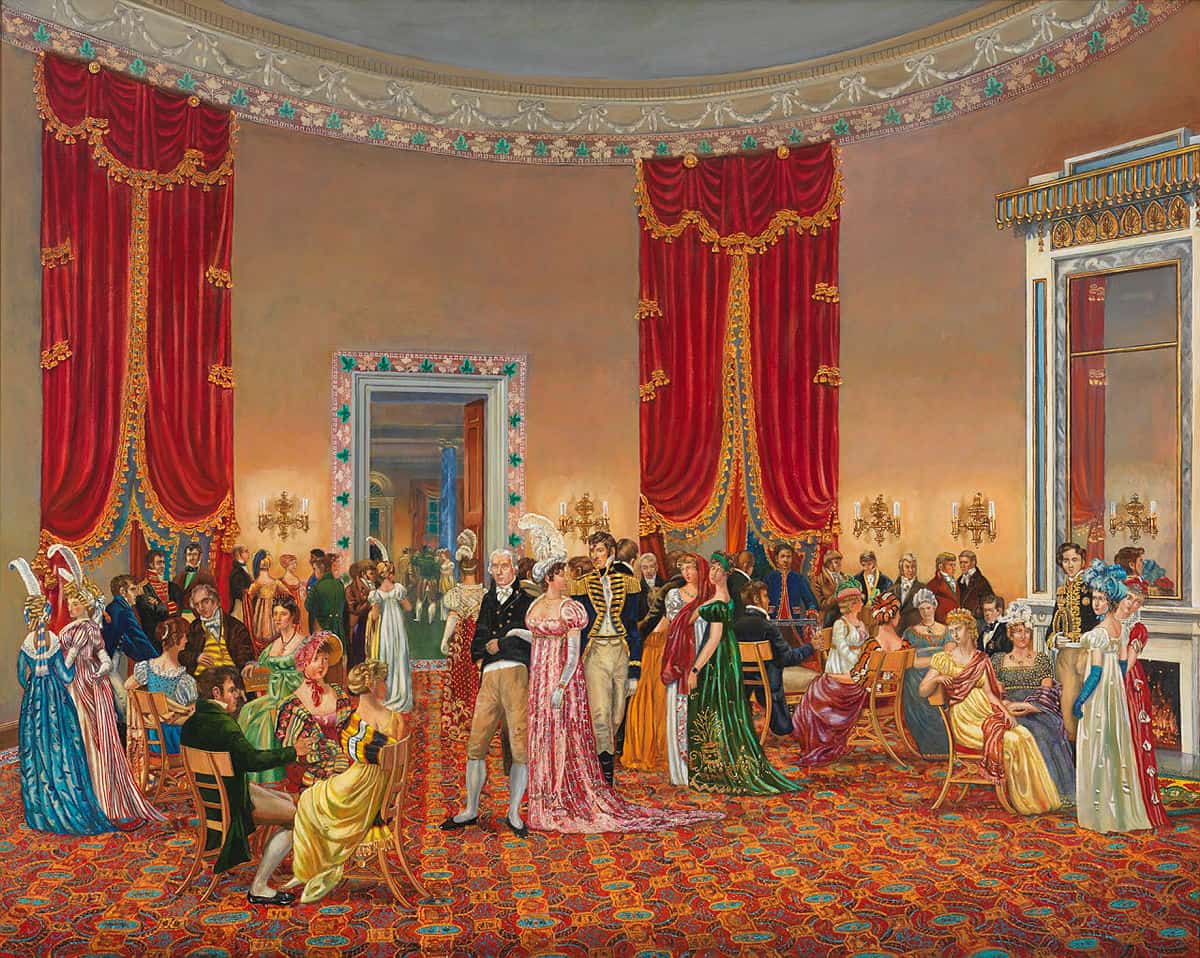
Among Dolley Madison's most beloved entertaining traditions were her afternoon teas, at which she regularly served her Woodbury Cinnamon Teacakes. Preserved in early White House records, the recipe has come down to us through The Presidents' Cookbook - a document of American culinary history that deserves far wider readership than it currently receives.
Our Adapted Recipe
I have slightly refined Mrs. Madison's Woodbury Teacakes from the original. The essence - and the spirit - remain entirely the same, but the texture has been improved for the modern kitchen.
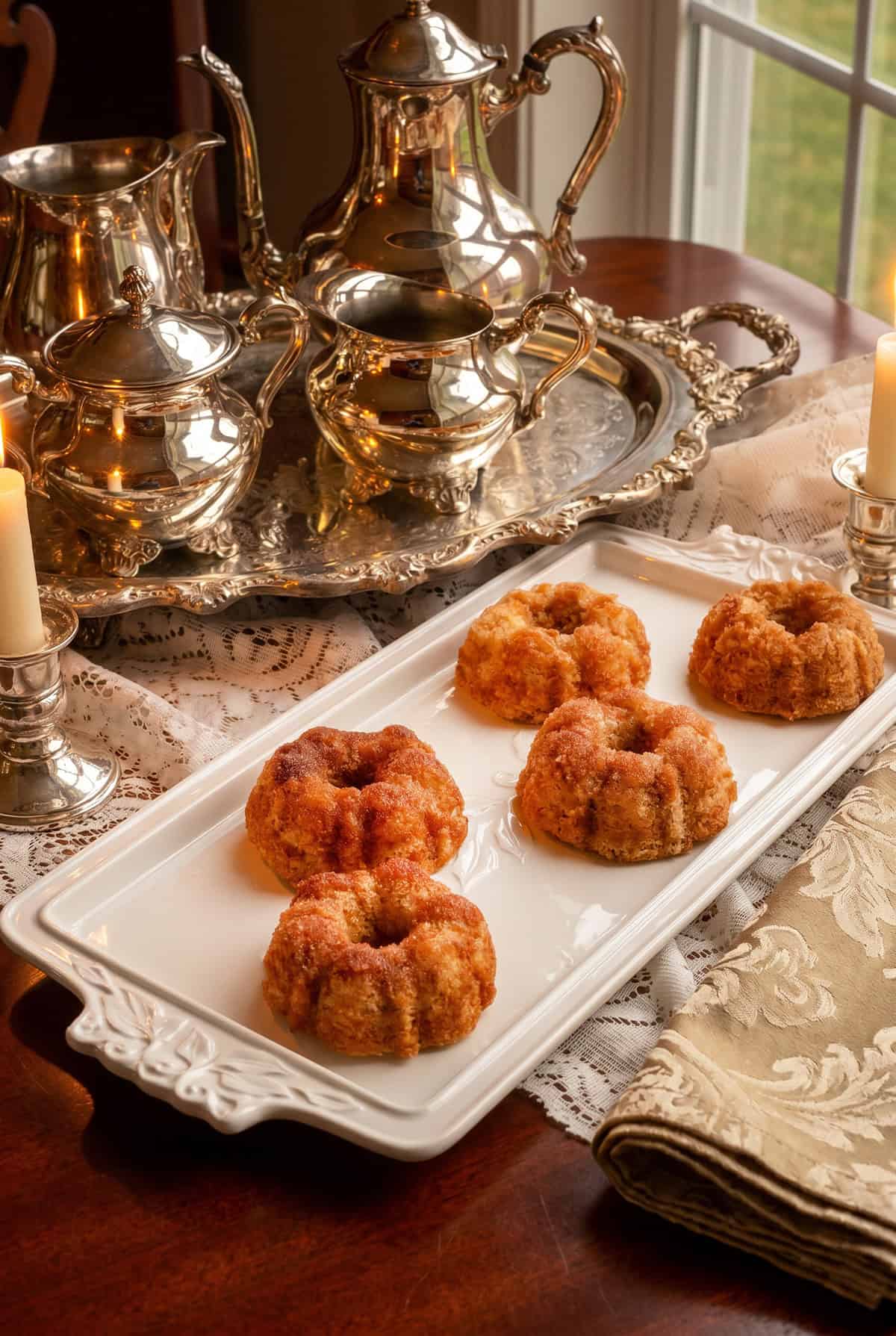
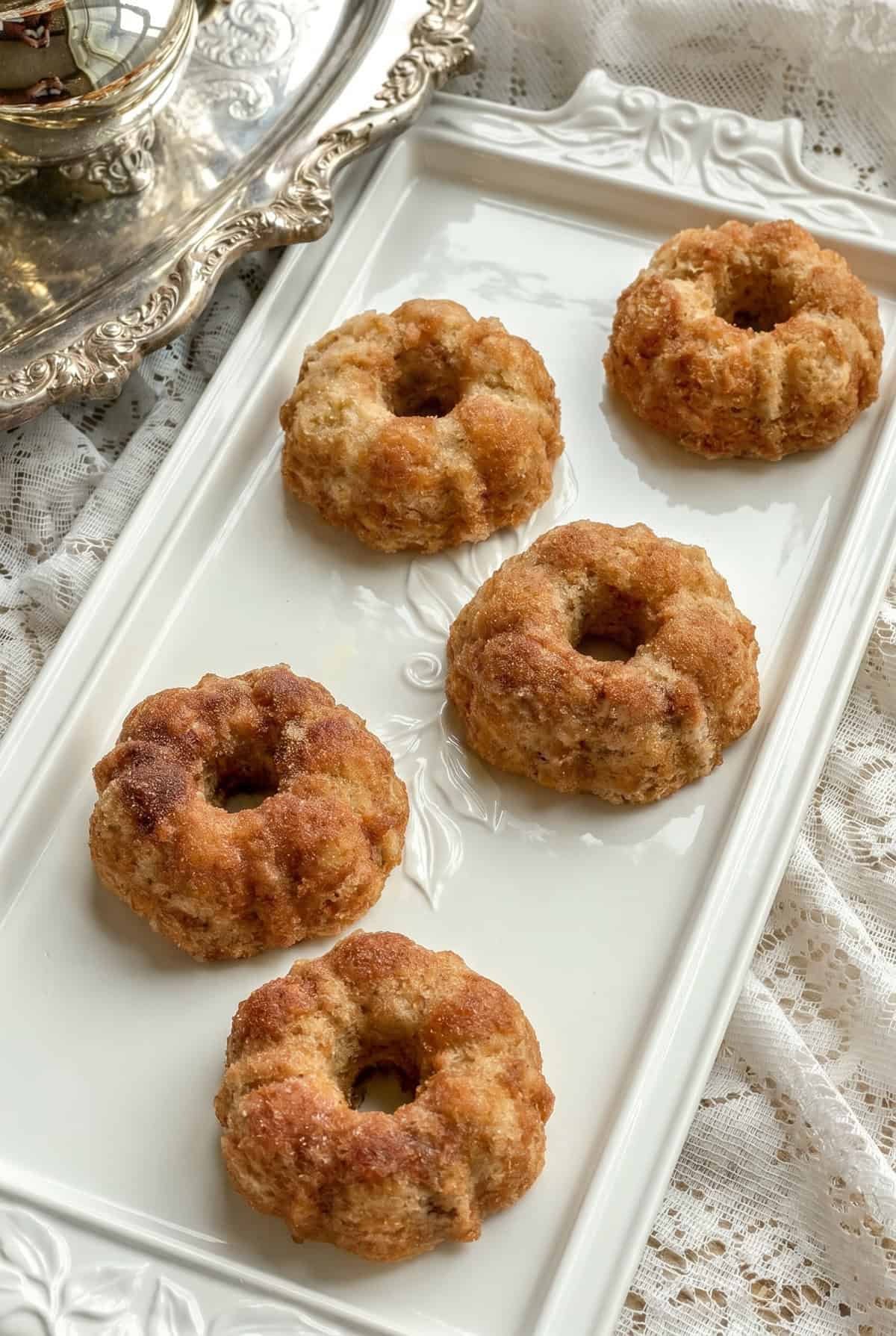
I love to make them in mini Bundt pans, where they emerge as elegant little cakes with beautiful ridged edges that hold a light dusting of powdered sugar. They work equally well in any ringed pan, or cut into rounds or traditional shapes.
Serve with tea. That part is not optional.
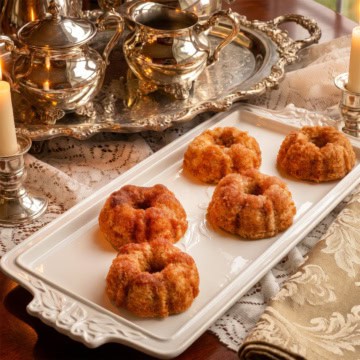
First Lady Dolley Madison's Woodbury Cinnamon Teacakes
Equipment
Ingredients
- 4 tablespoons butter, softened
- 1 cup sugar
- 2 large egg
- ½ cup milk
- 1 teaspoon vanilla
- 1 ½ cups all-purpose flour
- 1 tablespoon ground cinnamon
- 1 teaspoon baking powder
- ½ teaspoon salt
Cinnamon Sugar Topping
- 4 tablespoons butter melted
- ¼ cup cinnamon sugar mixture
Instructions
- Preheat the oven to 350 degrees and grease a mini Bundt pan with nonstick cooking spray that contains flour, or butter and flour the pan so the cakes will easily come out of the forms after baking.
- In a bowl, whisk together the flour, baking powder, salt, and cinnamon. Set aside.
- Beat the butter and sugar until creamed together. Then add the eggs, one at a time, and beat until light and fluffy. Stir in the milk and vanilla.
- Fold in the flour mixture until just combined. Be careful not to overmix. Transfer the batter to the mini Bundt pan. I like to add the batter to a large zip-lock bag, cut one of the tips, and pipe it into the pan.
- Bake for 15 to 20 minutes or until a toothpick inserted in the middle comes out clean.
- Remove from the oven and let cool in the pan for 3-5 minutes. Then invert the cakes onto a metal rack for cooling. Immediately, while the teacakes are still warm from the oven, brush 4 tablespoons of melted butter over the surface. Then sprinkle the cinnamon-sugar mixture over the teacakes.
Nutritional information is only an estimate. The accuracy of the nutritional information for any recipe on this site is not guaranteed.
Serving These Teacakes for America's 250th
As America marks its 250th anniversary this summer, the Woodbury Teacakes feel newly relevant - a direct thread from the founding table to the present one.
For a 250th afternoon tea, consider serving them alongside historically-grounded companions: Election Cake, which has its own deep roots in early American celebration tradition, or a cup of Colonial Bohea tea from Oliver Pluff & Co. in Charleston - a recreation of the very teas that were aboard the ships in Boston Harbor in 1773. Liberty Tea is a delicious herbal tea that also pairs well with these Colonial Scones, which are a historically accurate and delicious accompaniment along with fruit.
The table that Dolley Madison set was an act of belief in what America could become. Setting one now, with her recipe at the center, is a quiet way of honoring that same belief - 250 years on.
What Tea to Serve
Dolley Madison would have served loose-leaf Chinese tea - the only kind available in the early 19th century, imported through the same East India Company trade routes that had fueled the tensions of the Boston Tea Party thirty years earlier.
For a historically-minded pairing:
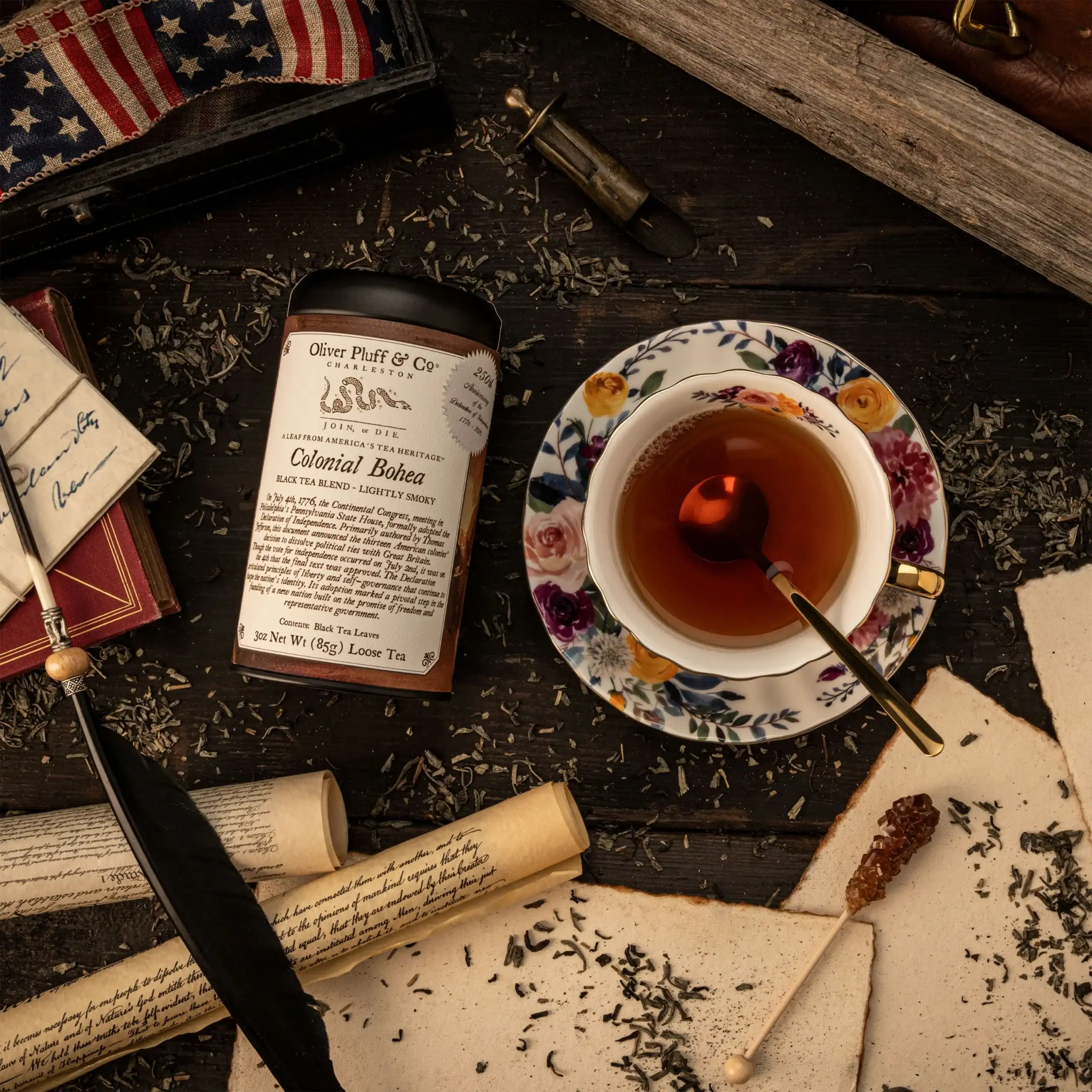
- Colonial Bohea from Oliver Pluff & Co. - smoky, winey, and warm, this is the closest modern equivalent to what was in the teacup at Dolley Madison's table. A remarkable cup of history.
- Lapsang Souchong - from Harney & Sons or your local tea shop, this is the more widely available cousin of the Bohea. Its distinctive smoky warmth is a beautiful counterpoint to the cinnamon of the teacakes.
- A strong breakfast tea - if history is not the point and warmth is, a robust Assam or Irish Breakfast tea is a natural partner for a heavily-spiced cake.
White House Recipe Resources
For anyone who wants to go deeper into the culinary history behind these teacakes:
The Presidents' Cookbook - the primary source for this recipe, available through Amazon, eBay, and Biblio. Out of print but findable, and worth every effort, it is a lovely addition to my library.
The White House Cook Book (1887) - a remarkable document full of recipes, menus, etiquette, and domestic guidance from the Gilded Age. A free digital copy is available online and is a wonderful afternoon's reading.
More Recipes You May Also Enjoy
If you try this recipe, I'd love to hear your comments and consider giving it a 5-star rating. Explore the recipe index for more easy, delicious ideas, and stay updated by subscribing to our newsletter and following us on Facebook, Pinterest, Instagram, and YouTube!
My wife made these for a President’s Day tea, and they were really good, everyone enjoyed them!
Was there a reference to the origins of the original recipe in The Presidents’ Cookbook: Practical Recipes from George Washington to the Present?
There was not any notes that I could put my finger on as to the origins of the original recipe. I would love to know too!
should the egg yoke be switched to egg white? I have never heard of beating an egg yoke?
Thanks,
Hi Ann -- Thank you! You're absolutely right. Obviously my fingers and my brain were not connecting. I have updated the text. It is now correct. Thanks for bringing it to my attention!