
Paska: Ukrainian Easter Bread
This post may contain affiliate links. Please read our disclosure policy.


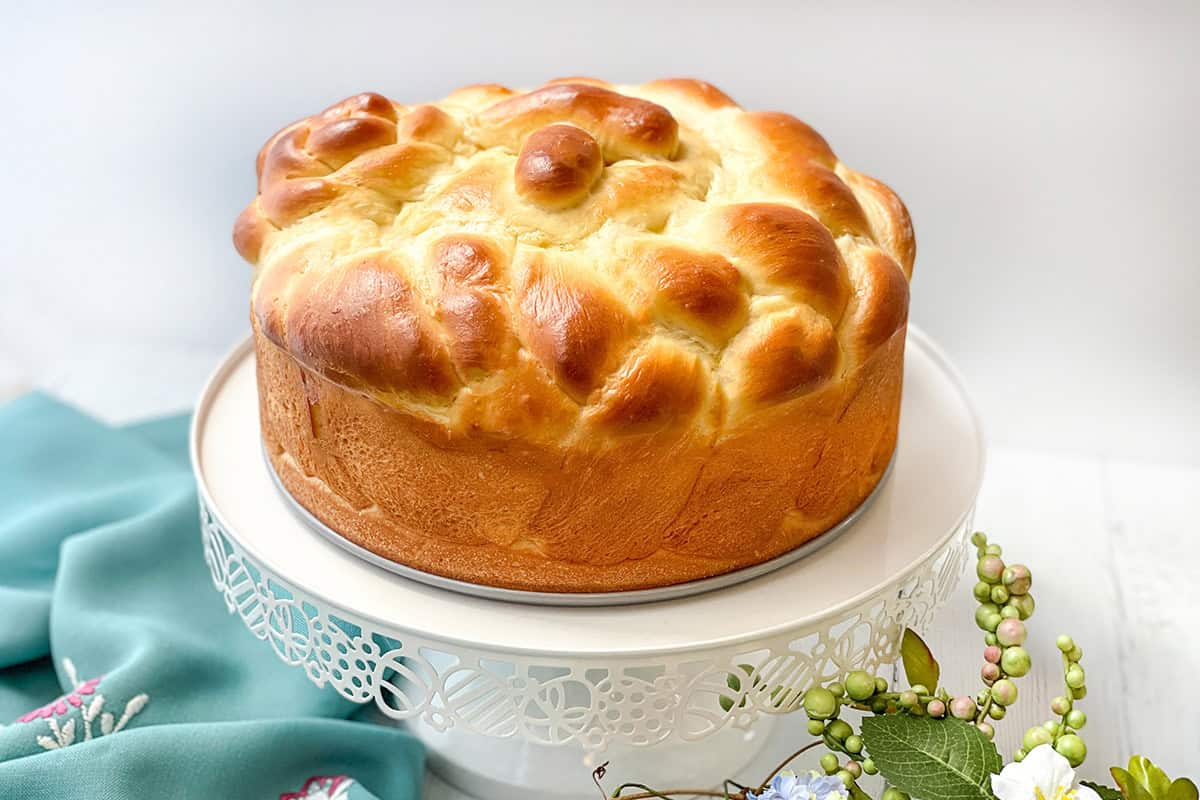
Paska is a traditional Ukrainian Easter bread with a soft, lightly sweet crumb and a beautifully decorated top. This paska recipe is baked in the round, enriched with eggs, butter, and milk, and finished with classic symbolic braiding that makes it especially lovely for Easter.
If you enjoy traditional Easter breads, you might also love my Ukrainian Kulich Easter Bread, another festive holiday loaf with a slightly different shape and texture.
Want to save this recipe?
Enter your email, and we'll send it to your inbox. Plus, you'll get delicious new recipes from us every Friday!
Why You'll Love This Paska Recipe
This traditional paska recipe is:
- Soft and lightly sweet with a tender crumb
- Made with simple pantry and refrigerator ingredients
- Beautiful for Easter brunch, breakfast, or Easter dinner
- Easier to shape than it looks
- A meaningful bread to bake for holiday traditions
Jump to:
- Why You'll Love This Paska Recipe
- What is Paska?
- My Link to Ukrainian Easter Bread
- Ukrainian Paska Ingredients
- How to Make Ukrainian Paska
- Chef's Tip: For an Extra Rich Heritage Crumb
- Tips for Making the Best Paska
- Troubleshooting Paska
- How to Serve Paska
- How to Store Paska
- Traditional Easter Breads Around the World
- Recipe FAQ's
- Paska: Ukrainian Easter Bread Recipe
- More Recipes You May Also Enjoy
- 💬 Comments
What is Paska?
Paska is a traditional Ukrainian Easter bread made with an enriched yeast dough of flour, eggs, milk, butter, and sugar. It is often baked in a round loaf and decorated with braids or symbolic shapes for the Easter holiday.
In many families, paska is part of a deeply rooted Easter tradition. It may be served at Easter breakfast, brunch, or dinner, and in Ukrainian custom, it was often taken to church in a special Easter basket to be blessed before the holiday meal.
My Link to Ukrainian Easter Bread
My great-grandparents were Germans living in the Odesa region of Ukraine, and when they immigrated to the United States, they carried many of their Easter traditions with them.
My grandmother was known as a bread baker, and although I never knew her personally, I've gathered her stories through family journals and the memories shared by great-uncles and aunts.
She was especially known for her Easter breads, and I love carrying forward some of those meaningful family traditions in my own kitchen each spring.


Ukrainian Paska Ingredients
You'll need a handful of familiar baking ingredients to make this traditional paska recipe. Exact measurements are in the recipe card below.
- Flour: Bread flour gives the loaf a bit more structure, but all-purpose flour also works well.
- Yeast: You can use either active dry yeast or instant yeast. Proof active dry yeast in the warm milk; instant yeast can be mixed right in with the flour.
- Sugar: Adds gentle sweetness and helps feed the yeast for a good rise.
- Milk: Warm milk enriches the dough and helps create a soft, tender crumb.
- Butter: Adds richness and flavor. Melt it and let it cool slightly before mixing into the dough.
- Eggs: Give the bread its rich color, structure, and soft texture.
- Vanilla extract: Adds a subtle warmth and sweetness that complements the enriched dough.
- Salt: Balances the sweetness and strengthens the dough.
How to Make Ukrainian Paska
This paska recipe comes together in a series of simple bread-making steps: mixing the dough, kneading, rising, shaping, and baking. The decorative top makes it feel special for Easter, but the process itself is very approachable.
More detailed instructions are in the recipe card below.
Step 1: Activate the yeast
Begin by warming ½ cup of milk to lukewarm or 110°F. Dissolve 1 teaspoon of sugar in the milk and then sprinkle the yeast on top. Let it sit and activate for 5 to 10 minutes or until the yeast is bubbly. Meanwhile, oil a bowl for the dough to rise and set aside.
If you are using instant yeast, add it directly to the flour.


Step 2: Make the sweet dough and knead
Whisk 4 cups of flour, the sugar, and salt in the bowl of a stand mixer or in a large mixing bowl. If using instant yeast, add it here. Stir in the yeast mixture, eggs, melted butter, remaining milk, and vanilla.
Mix until the dough forms a thick, sticky mass. Add the remaining flour gradually, mixing by hand or with the dough hook until the dough begins to pull slightly from the sides of the bowl. Depending on humidity and the flour you use, you may need closer to 7 cups.
If mixing in a stand mixer, knead the dough for 6 to 7 minutes or by hand for 10 minutes. As the bread kneads, the moisture will be absorbed into the flour.

Step 3: First Rise
Shape the dough into a ball and place it in the oiled bowl. Cover with plastic or a damp kitchen towel and let rise in a warm spot for 60 to 90 minutes.
Step 4: Shaping the Dough and Second Rise
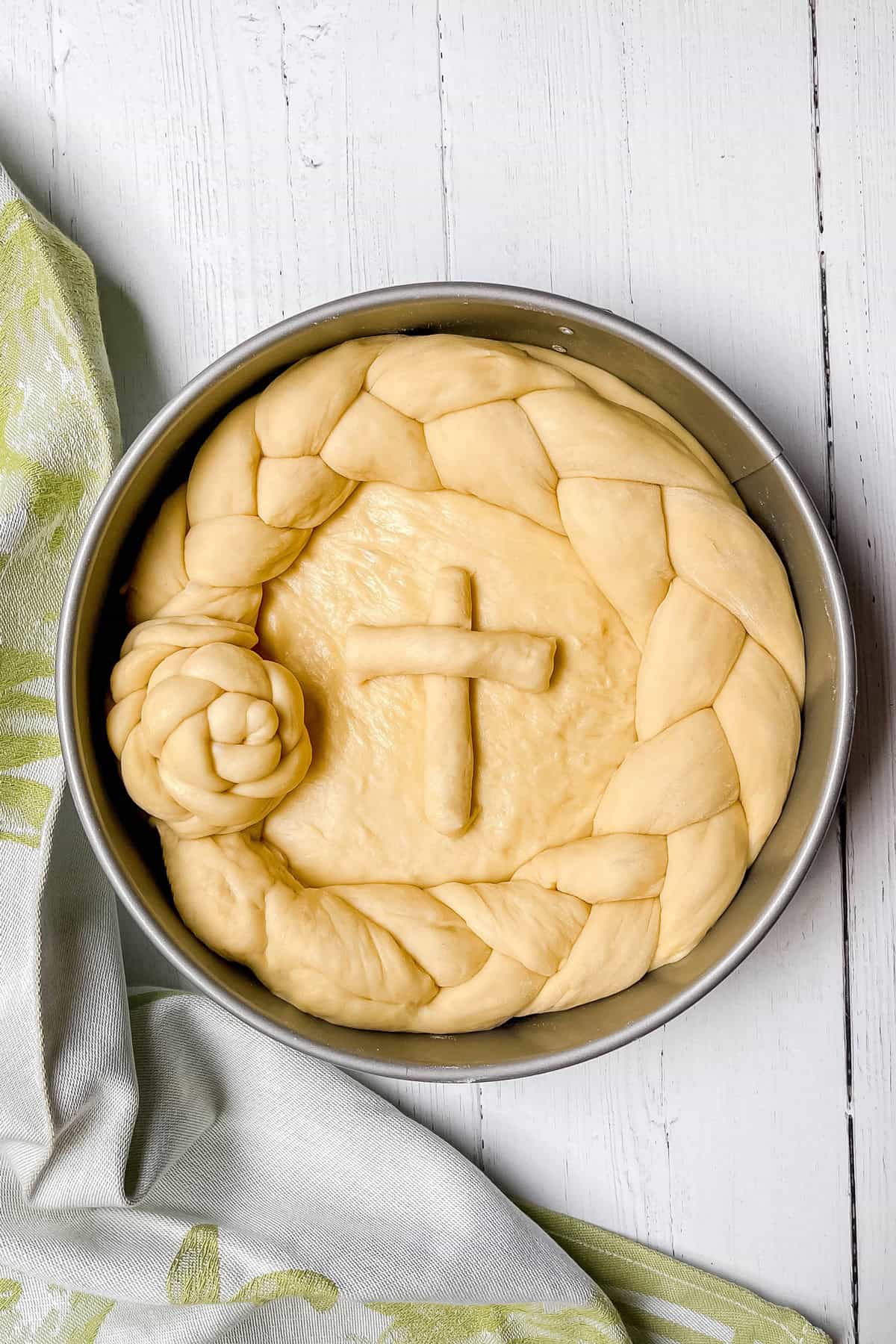
Deflate the dough and transfer it to a lightly floured surface. Divide the dough in half. Shape one half into a disk and press it into the bottom of the prepared springform pan.
Divide the remaining dough into 4 pieces: 1 piece for the cross and 3 pieces for the braid.
For the braid: Create 3 ropes, each about 18-20 inches long. Braid and place on top of the dough's outer edges in the pan.
For the cross: Separate into two pieces, one slightly longer than the other, and create a cross pattern; place in the middle of the bread.
Cover and let rise until almost doubled. Meanwhile, preheat the oven to 350°F.
Step 5: Bake the Paska
Brush the loaf with egg wash and bake for 40 to 50 minutes, or until the bread is deeply golden and baked through.
I begin checking at 35 minutes and cover the top of the bread with parchment paper or foil if it is browning quickly. Remove the bread from the oven and let it rest in the pan for 10 minutes. Then, remove it from the pan and place it on a rack to cool completely.
Chef's Tip: For an Extra Rich Heritage Crumb
If you're looking for the deep golden, velvet-like texture typical of traditional Ukrainian paska, I recommend adding 1 additional egg yolk to the 3 whole eggs called for in the recipe (for a total of 3 whole eggs + 1 yolk).
What to Expect with the Flour-to-Egg Ratio:
- The Dough Texture: Adding the extra yolk increases the richness without making the dough overly sticky. However, enriched doughs love to "soak up" flour. Start with 6 cups of flour and gradually add the remaining cup only until the dough begins to pull away from the sides of the bowl.
- The "Tacky" Rule: Aim for a dough that is soft and slightly tacky to the touch-not dry like a standard sandwich bread. A moist dough ensures a light, airy paska; too much flour will make it dense.
- The Shine: Don't let that extra egg white go to waste! Use the remaining white from your extra yolk to create your egg wash. Simply whisk it with a teaspoon of water and brush it over your braids just before baking for a beautiful, high-gloss finish.
Tips for Making the Best Paska
- Start with properly warm milk. It should feel warm, not hot, about 110°F, so the yeast activates without being damaged.
- Expect a soft, slightly sticky dough. Add flour gradually. You want a manageable dough, but not a dry one.
- Let the dough rise in a warm place. A draft-free kitchen helps the dough rise more consistently.
- Don't overflour while shaping. Too much extra flour can make the finished loaf heavier.
- Cover the loaf if it browns too quickly. A loose piece of foil or parchment over the top during the last part of baking works well.
- Cool completely before slicing. This helps the crumb set and keeps the bread from becoming gummy.
Troubleshooting Paska
Even if you're new to baking Easter bread, these simple tips will help ensure a beautiful and successful paska. Here are some common questions and easy fixes:
Why is my paska dense?
This is usually caused by adding too much flour or not allowing enough time for the dough to rise. The dough should be soft and slightly sticky, and it should double in size during each rise.
Why didn't my dough rise?
Check that your yeast is active and that your milk wasn't too hot or too cool. Yeast thrives in warm (not hot) liquid-about 110°F is ideal.
Why is my bread dry?
Too much flour or overbaking can lead to a dry loaf. Measure flour carefully and begin checking for doneness toward the lower end of the baking time.
Why is the top browning too quickly?
This is common with enriched doughs. If needed, loosely cover the loaf with foil during the last part of baking to prevent over-browning.
Why did my decorative braids lose their shape?
If the dough is too soft or over-proofed, the decorations can spread. Lightly press them into the loaf and avoid over-proofing after shaping.
How to Serve Paska
Paska is lovely served slightly warm or completely cooled. I love it sliced with butter alongside Easter breakfast or brunch, but it's equally welcome on the holiday table later in the day.
You can serve it with coffee or tea in the morning, or add it to a spring meal with ham, egg dishes, and other Easter favorites. For a beautiful holiday spread, pair it with your Easter brunch recipes, breakfast ideas, or festive Easter dinner dishes.
How to Store Paska
Store paska tightly wrapped at room temperature for 2 to 3 days. Because it is an enriched yeast bread, it is best the day it's baked and still very good the next day as well.
For longer storage, wrap the fully cooled bread well and freeze it for up to 2 months. Thaw at room temperature, then warm slices gently if desired before serving.
Traditional Easter Breads Around the World
Many cultures celebrate Easter with beautiful enriched breads, each with its own shape, symbolism, and tradition.
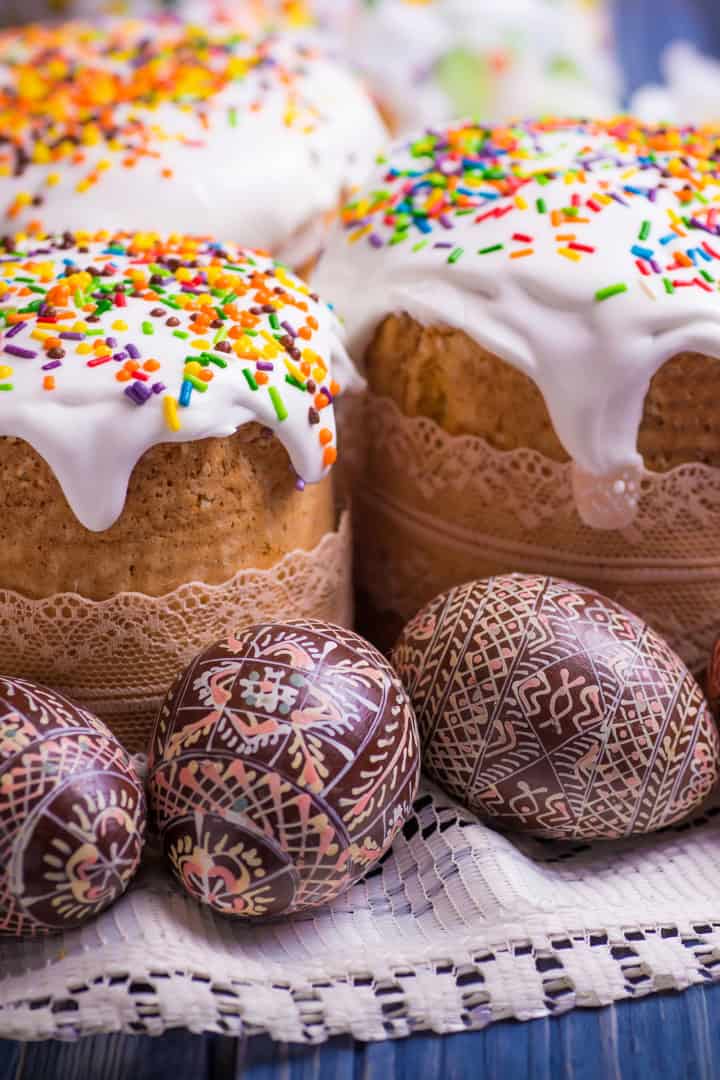
- Ukrainian Kulich Easter Bread is a taller, cylindrical loaf, often topped with a light glaze and sprinkles.
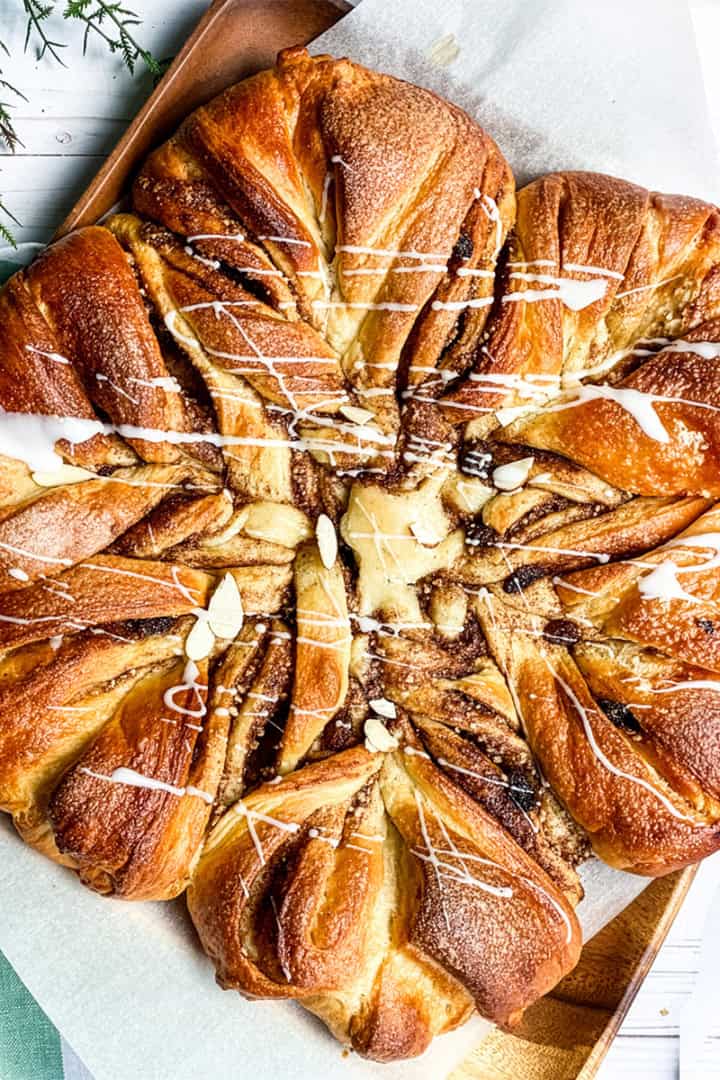
- Babka is a rich, swirled yeast bread, often filled with chocolate or cinnamon, and beloved across Eastern Europe.
- Kugelhopf is a slightly less sweet, brioche-like bread baked in a fluted mold, common in Central Europe.
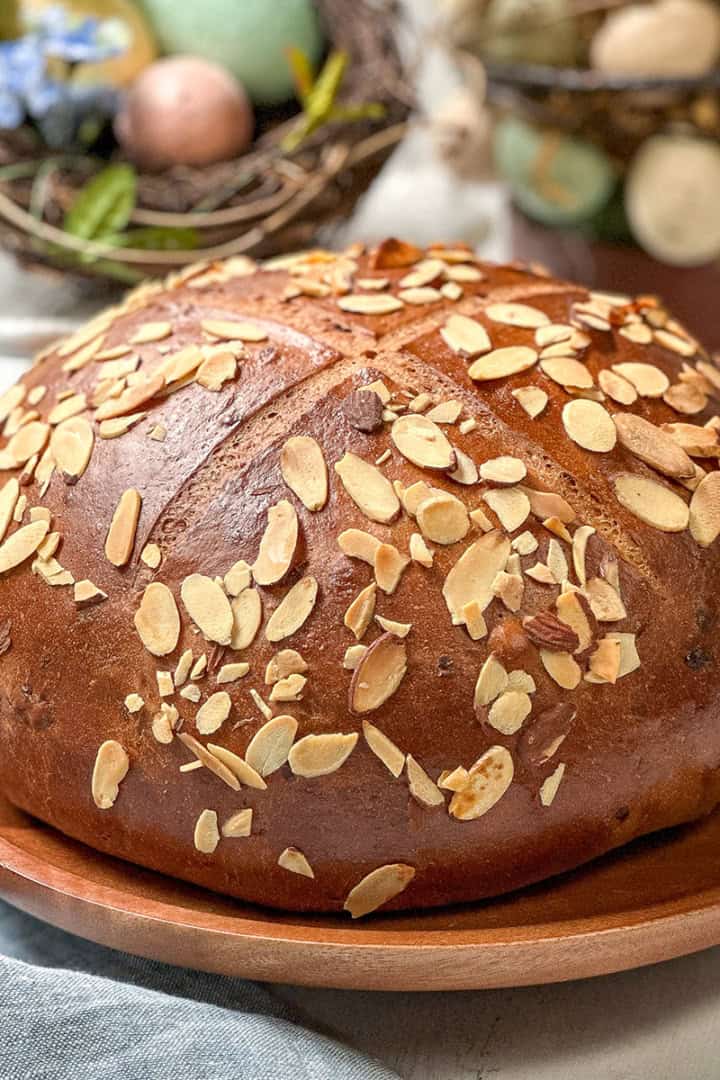
- Osterbrot (German Easter Bread) is a soft, lightly sweet loaf often made with raisins and almonds.
While each bread is unique, they all share a common thread-celebrating the season with something beautiful, comforting, and made from simple ingredients. See my Easter Breads from around the world for more recipe ideas.

Recipe FAQ's
Paska is a traditional Ukrainian Easter bread made with an enriched yeast dough of eggs, butter, milk, and sugar. It is typically baked in a round loaf and decorated with braids or symbolic shapes for the Easter holiday.
Both are traditional Easter breads, but they are often shaped differently. Paska is commonly baked as a round decorated loaf, while kulich is usually taller and more cylindrical.
Yes. A deep cake pan or similarly sized round baking pan can work, as long as it is well greased and supports the loaf as it rises and bakes.
Yes. Bread flour gives a bit more structure, but all-purpose flour works beautifully in this recipe too.
Dense paska is often the result of too much flour, under-kneading, or not allowing the dough enough time to rise in a warm spot.
Yes. Paska can be baked a day ahead and wrapped tightly once fully cooled. It's a lovely make-ahead Easter bread.
Paska: Ukrainian Easter Bread Recipe
Equipment
Ingredients
- 2 cup warm milk 110℉ (32℃)
- ¾ cup sugar divided
- 1 tablespoon active dry yeast or instant yeast
- 1 cup unsalted butter melted
- 4 large eggs + 1 egg yolk (divided) at room temperature
- 2 teaspoons vanilla extract
- 6-7 cups flour bread flour or all-purpose flour
- 2 ¼ teaspoon salt

Instructions
For the dough
- Coat a large bowl with oil and set it aside.
- Warm the milk to 110℉ (32℃), or just warm to the touch. Dissolve 1 teaspoon of sugar in ½ cup lukewarm milk. Sprinkle the active dry yeast on top. Set it aside in a warm place for 5 to 10 minutes or until the yeast is bubbly. If using instant yeast, add it with the flour.
- In the bowl of a stand mixer or large bowl, whisk 4 cups of flour, instant yeast (if using), salt, and remaining sugar. Stir in the proofed yeast mixture, 3 eggs plus an egg yolk, melted butter, milk, and vanilla. Mix to incorporate the ingredients until smooth and batter-like. Begin adding the remaining flour (2 cups), mixing by hand or with the dough hook attachment on a stand mixer until a sticky dough forms. It will only slightly pull away from the sides of the bowl. Depending on the day, I often need about 7 cups of flour. Add additional flour as needed.
- Knead by hand for about 10 minutes or in a stand mixer for about 6-7 minutes. The dough will be soft and somewhat sticky.
First rise
- Transfer the dough to the oiled bowl, cover it with plastic or a damp kitchen towel, and let rise in a warm, draft-free area until doubled in volume, 60-90 minutes. When close to the end of the first rise, lightly grease a 9-inch springform pan or a 10-inch springform pan.
Shape the loaves:
- Deflate the dough and transfer it to a lightly floured surface. Divide the dough in half.
- Shape half the dough into a circular disk shape and fit it into the bottom of the prepared springform pan. Set aside.
- Divide the remaining dough into 4 pieces: 1 piece for the cross and 3 pieces for the braid.
For the braid:
- Form three 18 to 20-inch ropes. Braid the ropes together and place them on top of the outer edges of the disk in the pan, leaving an open area in the middle. Pinch and seam the edges together.
For the cross:
- Separate the remaining piece of dough into two pieces, one slightly longer than the other, and create a cross pattern; place in the middle of the bread.
- Cover the bread in the sprinform pan and let rise until almost doubled, about 1 hour. Meanwhile, preheat the oven to 350°F.
Bake the Paska:
- Whisk the remaining egg and the remaining egg white together for an egg wash. Brush the top of the bread just before baking.
- Bake for 35 to 50 minutes, or until the bread is baked through; this will depend on how large the loaf is. I begin checking at 35 minutes and cover the top of the bread with parchment paper or tent with foil if it is browning quickly. The bread is done when the crust is golden; there is a hollow sound when tapping on it or when the internal temperature is 190 degrees F on an instant-read thermometer.
- Remove from the oven and rest in the pan for 30 minutes. Then remove the pan and place it on a rack to cool completely.
Video
Notes
- Flour Tip: Start with the lower amount of flour and add more gradually as needed. The dough should be soft and slightly sticky, but still manageable. Too much flour can make the bread dense.
- Yeast: Active dry yeast should be dissolved in warm milk (about 110°F) until foamy. If using instant yeast, you can mix it directly in with the flour.
-
Variations: For a citrus note, add the zest of 1 lemon or orange to the flour mixture. It adds a lovely brightness to the finished bread.
If adding raisins, soak them in warm water for about 15 minutes, then drain well and gently knead into the dough before the first rise. - Decorating the Top: Reserve a small portion of dough to create braids or traditional shapes for the top. Lightly press them onto the loaf after shaping so they adhere during baking.
- Extra Dough: If you have leftover dough from shaping, form it into a small braid or round loaf. Let rise until doubled, then bake on a sheet pan for 15-20 minutes. It makes a wonderful baker's treat.
- Baking Tip: If the top begins to brown too quickly, loosely cover with foil during the last part of baking.
- Doneness: The bread should be deep golden and sound hollow when tapped. If you have a thermometer, the internal temperature should be about 190-200°F.
- Make Ahead: Paska can be baked a day ahead. Let it cool completely, then wrap tightly and store at room temperature.
- Storage: Store tightly wrapped at room temperature for up to 2-3 days, or freeze for longer storage.
Nutritional information is only an estimate. The accuracy of the nutritional information for any recipe on this site is not guaranteed.
More Recipes You May Also Enjoy
- Italian Easter Bread
- Ukrainian Kulich Easter Bread
- German Easter Bread (Osterbrot): Easy Sweet Bread
- Almond Cinnamon Babka Star Bread
If you try this recipe, I'd love to hear your comments and consider giving it a 5-star rating. Explore the recipe index for more easy, delicious ideas, and stay updated by subscribing to our newsletter and following us on Facebook, Pinterest, Instagram, and YouTube!
Can I use a hand mixer?
Hi Dawn! Yes, it’s possible to use a hand mixer with some adjustments. Be sure to use the dough hook instead of beaters or the whisk attachment. Because a hand mixer motor isn’t as powerful as a stand mixer, there is a risk of burning the motor. I would mix the flour and liquids together by hand first, and then use the mixer. Give it a rest every two to three minutes of mixing to help reduce that risk. Thank you for your question!
My bread was horribly ugly but tasted good. It made the best bread pudding we have ever had.
Hi Tina! Thank you for sharing this — you gave me a good smile. Paska has a way of humbling even experienced bakers, and beauty is always in the eye of the beholder! I’m so glad it tasted good, and even happier to hear it became the best bread pudding you’ve ever had — that’s a wonderful second life for it. Thank you for baking it and for taking the time to leave such a thoughtful note.
Correction.....9" springfirm pan. 🙈
That is a great question! Since Paska is a tall bread, a standard 9-inch cake pan is much shallower than the springform pan the recipe calls for. You can definitely make it work, but you'll need to give the dough some 'walls' to climb so it doesn't spill over.
The Parchment Collar Trick:
Create a Chimney: Cut two long strips of parchment paper about 6 inches wide. Butter the inside rim of your cake pan to act as glue, then line the inside with the parchment so it stands about 4 inches above the rim.
The 'Sling' Secret: Before adding the collar, place two long, narrow strips of parchment across the bottom of the pan in a '+' shape, leaving 'handles' hanging over the sides. This will help you lift the bread straight up out of the pan since you won't have the springform latch to release it.
Bake on a Sheet: Place your cake pan on a baking sheet for stability. If the top browns too quickly inside its parchment 'chimney,' just loosely tent it with foil for the last 10–15 minutes.
I can’t wait to hear how your Paska turns out!
Good morning, I do not have a 8" Springform pan. Would a 9" round cake pan work? Thank you in advance.
Julie
Very good! It was not difficult to shape. It reminds me of a bread my grandmother made when I was a child.
This is one of my favorite Easter traditions. I'm so happy you enjoyed it!
Stephanie, I can't believe how much your grandmother looks like my Baba! She came over from Slovakia at 18 to marry someone she never met. (She didn't) Your recipe looks exactly like mine. I love the braiding on your loaf. Mine always goes wonky.
Hi Kathy! That is so special-- those women were (are) so incredible. What they faced with such courage is inspiring. It makes me happy we carry their DNA! And yes, yeasted braids can be trick-- each one is always different. I do use a scale or weigh the strands, which does help, but sometimes, they have a life of their own. Thank you for your comment -- I love hearing those stories. Have a great weekend.
Made this last Easter, and again this week. Turned out perfectly each time. Definitely on the list for our Easter gathering this year!
Stephanie,
Can you add cheese to this Paska recipe?
Thank you
Dave
Hi David! I've never added cheese to Paska, although "Paskha" is a cheese traditionally served for Orthodox Easter. It sounds like a great idea-- if you try it with cheese, I'd love to hear how you liked it!
Hi Corrie! Thank you for making the Paska last year. I'm actually baking my loaf this morning too. Traditional recipes for both Paska and Kulich do tend to be on the drier side. Although it shouldn't be too dry.
Flour: I've been using a higher protein flour in this bread. Canadian all-purpose flour contains higher protein than U.S. all-purpose flour so I'm using King Arthur unbleached bread flour. It helps create a little more structure and a chewy texture, which is good for bread! I begin with 5 3/4 cup flour along with other ingredients. Then I add small amounts of flour until it pulls away from the machine. For me, this usually ends up right about 6 cups of flour.
Kneading: Be sure to knead the bread (whether in a stand mixer or by hand) until the dough feels soft and smooth. In the mixer, I knead for about 5 minutes, or until the dough is a little stretchy. By hand, it usually takes about 10 minutes.
First Rise: Be sure to allow the bread to rise in a warm place for 90 minutes to 2 hours. I learned a great tip for a King Arthur bread maker that I'be been using for quite a while. He fills a small container with very warm water, cover the bowl with the rising dough and places it in the microwave. It creates this warm place for the bread to rise beautifully. I do this almost every time.
Second Rise: If it doesn't fit into the microwave, just place it in a warm, draft free place and let rise until almost doubled.
Baking temperature: You do want the bread is cook through. As you know, ovens vary greatly. The temperature of 190 degrees F is a standard measurement for most breads, except for baguettes which are better at 205-210 degrees F.
I hope these tips help! Let me know if you have any other questions.
Stephanie
Can you add fruit to this paska recipe? If so at what stage and does it change the bake time? Also do you need to grease the 9 inch springform pan? Once baked do you need to remove the paska immediately so it won't get soggy?
Hi Corrie, you can definitely add dried fruit to the paska! I like to add the fruit after the dough has been combined and in the middle of kneading it so it can fully incorporate. My springform pan is nonstick so I do not grease it. If you are using one that isn't nonstick, I would definitely grease with parchment or baking spray. After the paska is baked, I leave it in the pan for about 10-15 minutes, then carefully remove it from the pan to cool completely.
I made this for Easter. I wish I could upload a picture to show everyone how beautiful it looked. I didn’t do the braid but did put the cross on. I used less than the 6 cups of flour, probably about 5 2/3 cups. I baked it 40 minutes. It browned nicely but I thought it to be a little dry. Next time I will check it at 35 minutes. I’ve been toasting it & it is delicious.
It sounds beautiful! I wish you could upload a photo too! I'm actually looking into how that might be possible. And toasting that wonderful bread is one of my favorite things. Thank you so much for trying the recipe and letting me know how it worked for you.
My family is also German from the Ukraine. We always called it “baska” and grandma put anise and lemon flavoring with a scent of saffron. She would bake it tin coffee cans and frost the tops and decorate. It was a wonderful tradition.
Yes-- there should only be one measurement of salt!
Can I make this a day ahead or is it better to do it the say of?
Hi Bridget! It’s always best the day it’s made, but with the baking process, that’s not always feasible. Last year for Easter I made it a couple of days ahead, wrapped it very well and froze until Sunday. Everyone enjoyed it immensely!
I made this on 12/2/2022, good recipe. Just a few changes next time I make it, maybe a tablespoon or two sugar and some lemon rind for flavor, other than that it's good. I am polish and slovak and my Grandma and mom always added lemon rind. I'm just used to it. Try it some time.
Hi Don, thank you so much for trying the recipe. I'm glad you enjoyed it! I love your idea of adding lemon rind. My German from Russia grandmother added orange zest to her Kulich and other sweet bread recipes. I will definitely try adding lemon zest. Thank you for the suggestion.